Showing posts with label Music Reading. Show all posts

Thursday, January 19, 2012

Musicland Notes

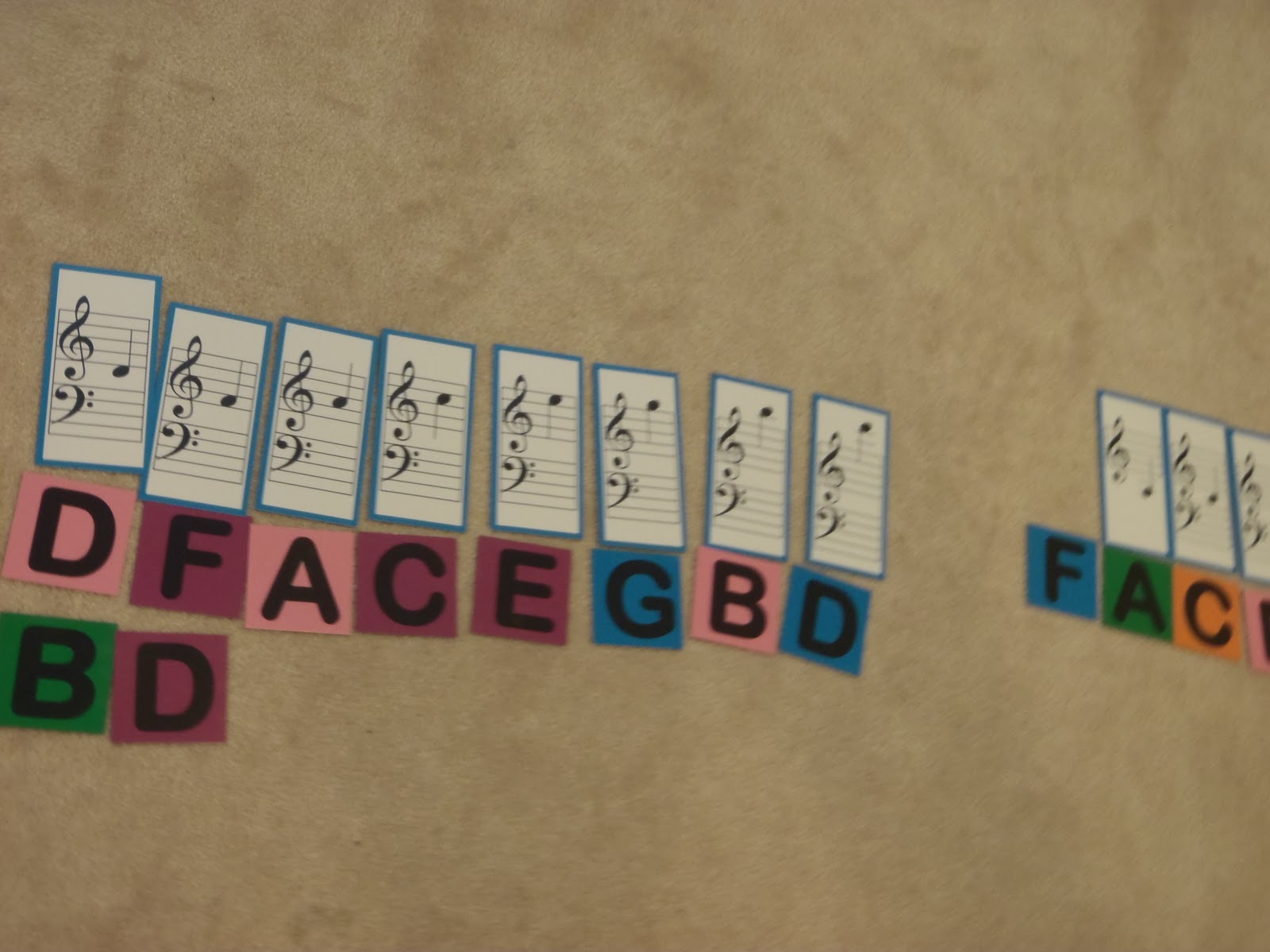
A young child can learn note reading and even music writing when it involves a large Staff paper and some common colourful objects such as juice caps!

Treble clef notes (top); Bass Clef notes (bottom). The Middle C above the bass clef staff sits on a small imaginary line.

At my group class last week, we played the game "On the Line, Off the Line" where the kids had to jump on/ off a little straw on the ground.  This was a lead-in to the topic of placing notes on the staff - on the line, in the space!

Method:
Review the Treble Clef, Bass Clef, count the lines (5), count the spaces (4)
Talk about the belly of the treble clef (second line). You could colour this line red for Red Giant.
Point out the dots in the bass clef (line four). You could colour this line blue for Blue Fairy.

The kids already know the friends in Musicland:
Yellow Cat
Purple Dragon
Green Elf
Blue Fairy
Red Giant
Orange Albert
Brown Beethoven (black cap)
Yellow Cat

Point out the small extra line below the treble clef staff for Middle C, ask someone to mark it using the yellow cap and call it Yellow Cat (on the line)
Have the next child place the next note, someone will know that it`s Purple Dragon (space just hanging below the staff)
The next child will catch on quickly that the next note is Green Elf (on the line 1)
...and so on.
Work to the next Yellow Cat and review the word ``Octave``

If applicable, move on to the Bass clef. Yellow Cat is in the space (second from bottom).

In fact one of the children recognized a pattern right away and he started to sing, Step-ping Up!  That was so wonderful that he could relate the notes on the page to tone direction though it wasn`t perfect pitch he still sang a sequence of stepwise notes in whole tones!

For an older child, take notes away and name the thirds (the space notes form thirds, as do all the line notes)
You could use the coloured notes to build chords in root position and all inversions!

Tuesday, October 18, 2011

Teaching Note Reading

I have a couple of transfer students who play with such joy and ease; they love the songs in the beginner books they've been working on with the previous teacher since last school year; they seem to feel sad about finishing the book and moving on. However, I quickly identified the underlying reason; the note reading skills needed to be ramped up a bit to keep up with the playing level. While teaching my student Teapot Invention in RCM Grade 1, I discovered that she was actually playing the song by copying the melody, phrasing and staccato from hearing and watching me play it. This is confirmed, because she was not looking at the book at all, it is a brand new song and yet she complained, "Sorry I can't remember how to play it". (Of course not, it's still new :)

Of course this whole scenario reinforces the whole idea that some young children learn to play alot better from hearing the song and learning by heart without note-reading. However to reach the next level we want to achieve, some serious intervention is required.

YELLOWCAT

The student is a model student for the Yellowcat method to teach the note reading, hand placement and maintain playing skills at the highest level. Find out more about Yellowcat at http://www.yellowcatpublishing.com/ and http://www.ycmused.com/ Here is the plan for the next four lessons.

Lesson 1
  • Musicland Story Chapter 1
  • Identify the Caves and Castles, Worksheet
  • Introduce Yellow Cat, Purple Dragon, Green Elf
  • Play: Cat Dragon Elf, Elf Dragon Cat

Lesson 2
  • Musicland Story Chapter 2
  • Introduce the Blue Fairy, Red Giant, Orange Albert and Brown Beethoven.
  • If they're ready, go to Bass Clef Notes and Treble Clef Notes
  • Halloween Hairy Scary Spider
  • If we're ready for sharps and flats, Halloween Lullaby

* Remember that the student already has a background in note reading, but appears to have trouble reading "fast enough" to play a song.

Lesson 3
  • Talk about Blue Fairy Flight Rules: Note Key Finger
  • Use Dragon Paw starter pages
  • Selections from Notebook for Mozart

Lesson 4
  • Review Blue Fairy Flight Rules: Note Key Finger
  • Use Dragon Paw starter pages
  • Identify songs printed from Yellowcat music sheets; music notes will still be printed in colour except for C's because "Cat turns black" in the Grand Piano Book.
I have an older beginner, he was 14 when he started beginners piano.  He plays very well and reads quickly now in traditional printed music, but we first started with Yellowcat.  One time we used standard black and white flash cards for note reading; he wanted to say "Blue Fairy" for F or whatever notes we were quizzing on.  Very cute. I told him, "That's ok you can say Blue Fairy if that helps you remember it better." The more important thing is to play "Blue Fairy" on the piano and have the brain make that connection with the finger placement.

Saturday, September 24, 2011

Blue Jello Surprise

I am proud to say that my three year old son can read the simplified score of Haydn's Surprise transcribed for piano, rhythmic reading while singing in tune, treble and bass clef! This is a bit amazing to me because he seems young to read music, considering he doesn't read in English yet.  He knows most of the letters in the alphabet but reading music rhythms, that is good training for future reading skills too.

 
The other thing to point out is that, the most popular lesson time with him is the "after bath, after story, after all the siblings have drifted off to sleep, why are you still walking around" time of evening.  We used to waste a lot of time counting sheep telling a favorite bedtime story with superhero variations until I was falling asleep. However we recently decided we could use that time to teach him his handwriting and even piano music; how about math?  What a funny guy. I can also say that AJ has applied knowledge because I let him sit quietly through other kid's lessons. Today, he started singing along Jello-blue rhythms with the new pieces.  I count him as my student #13. He always starts his lesson with a bow, and finishes with a bow. Thank you for my lesson! he shouts when he feels the lesson is long enough.

 
MATERIALS
  • MMG Blue Jello music rhythm cards (order from http://www.musicmindgames.com/)
  • A rhythm bag, which contains a bag of supplies from the kitchen that could be used to represent music notes.
Blue Jello Cards from http://www.musicmindgames.com/

 
NOTE VALUES
  • Whole note - formula can cover, 4 beats
  • Half note - two baby food jar caps, 2 beats x2
  • Quarter note - popsicle sticks, 1 beat x4; say Blue
  • Eighth note pairs - pipe cleaners x4 or 8 green bottle caps; say Jello
  • Sixteenth note group of 4 - blue bottle caps x 4 x4; say Huckleberry
  • Rest - whisper "rest" for short or long rests accordingly.

 
Here is a photo of the setup, at the end there is an excerpt from the score; maybe next time I will try to film it. It was just so much fun and I felt that he was so clever when he could understand it.


I started with the whole note; to introduce each new item I just asked for a trade, beat per beat. Say the rhythm pattern with the blue jello words after each trade.  This is good for explaining what is a sixteenth note and why it is called a sixteenth note.

 
MUSIC READING
Sight sing or play the "Purple Dragon Surprise" from the Musicland books (order from http://www.yellowcatpublishing.com/) but have the children point and read, sight sing alot.  This is a useful way to introduce a new piece.

Melodic and rhythmic singing of the Treble Clef line.  Afterwards AJ also wanted to point and sing the Bass Clef notes.

Sing-along the upper line for Treble Clef notes:
Jello jello, jello blue, jello jello, jello blue.
Jello jello, jello blue. Jello jello, blue jel -rest.
... in the second page there is a "huckleberry" four note sequence (sixteenth notes).

 
REPERTOIRE
Purple Dragon Surprise is also a good piece for demonstrating chords, note reading on lines and spaces, note repeat, note stepwise motion, question answer phrases, binary form, dynamics and the 5 C's (four are found).  Most of my students know this piece from analytical study, one will play it for the upcoming recital.

Monday, September 12, 2011

Music Mind Games Plan

This is a proposed plan for the Note Reading portion of the class, and the materials to be used from the Puppy Packet. Every two weeks we could focus on one learning from one set of materials and cover the topics based on the cards. I got this idea from the teacher blogger Emily on http://www.musicmindgames.com/


For example a game on alphabet cards could be Fine, Snake, Scrabble based on C scale, A minor scale or thirds, circle of fifths etc.

* Alphabet Cards
* Blue Jello Cards
* Staff Slates & Grand Staff Cards
* Tempo Cards
* Music Symbol Cards
* Notes & Rests Cards
* Rhythm Playing Cards
* Staff Slates & Do-Re-Mi Cards
* Real Rhythm Cards


If there were siblings who had their lessons back to back, I would start everyone off with a "game" for about 10 to 20 minutes. While one brother is doing his lesson, the sister/brother could continue with the game quietly. This keeps the other student occupied while still learning music theory in a fun way.

Games and variations we've played in class:
* Fine alphabet cards, do re mi, even temp and dynamics
* Name the Five C's (progress to D's and B's etc)
* Find the Five C's (from the stack of note reading cards)
* Huckleberry Jello rhythm reading, note value trading and music reading
* Snake sequential, thirds, fifths (alphabet cards)
* Fat Snake and sing ABCDEFG to tune of Twinkle theme
* Snake in thirds while placing the note reading cards (shows the notes on lines and spaces!)
* Melody Bingo
* Musicland and characters Bingo


Friday, September 9, 2011

Teaching the G's and F's

Another Music Reading Lesson

Use the Treble Clef belly as a landmark for G. Find the other G one octave up, mark these with Magic Notes.  Use the Bass Clef dots as a landmark for F, find the other F one octave down.

Game: Googly Eyes
From http://www.musicmindgames.com/node/688
Materials:  Melodic Bingo cards, Magic Notes
Have the students take turns grabbing a Magic Note to mark all the G's one round, F's or C's the next.

Use RED for C; BLUE for G; GREEN for F.

Teaching the C's

First Music Reading Lesson
Main point: Notes on the staff tell us which keys to play on the piano!


1) Describe the Grand Staff with the treble clef, bass clef.
2) Count the lines 1-5 from the bottom.
4) Count the spaces 1-4 from the bottom.
5) Point out the belly of the treble clef aka Trebellina or Mrs Treble Clef; point out the two dots of Rock Bassy or Mr Bass Clef.
6) Place a red Magic Note on middle C (draw a short line for middle C)
Place an orange Magic Note on treble C or Twinkle C (3rd space)
Place an orange Magic Note on bass C (2nd space)
Place a yellow Maggic Note on the high treble C (draw two leger lines about the staff)
Place a yellow Magic Note on the low bass C (draw two legel lines below the staff)
7) Talk about the symmetry
8) Listen for high sounds and low sounds, play these on the piano and have the child identify which is being played.

Bonus: Use the word Octave to describe the jump between one C  to the next.


Second Music Reading Lesson
Main Point: Use the ABC cards to talk about the musical alphabet.

1) Ask the student to recite the alphabet A to G.
2) Now explain that the musical alphabet begins from C. Lay these out on the table in sequence.
Hint: Use the Do-Re-Mi rainbow colours or alternatively, the Musicland colours (yellow Cat, purple Dragon, green Elf, etc) or all uniform colours.

3) Talk about direction, going up (play the scale up, C major or C chromatic) and notes going down (play the scale down, C major or chromatic)

4) Ask the child to say the musical alphabet forwards and backwards. If there is some difficulty refer to the cards; indicate that the child should practise this at home, as a an assignment.

Next week: Music Mind Games for alphabet learning.

Thursday, January 7, 2010

Lesson 4: Resting

Hello Everyone.

Musicland Adventures, Musicbytes 4
1. Lesson Overview
2. Homework Assignment
3. Other
4. Free Heintzman piano, delivery included!

LESSON OVERVIEW: Resting With Green Elf
Katelyn dressed as Blue Fairy; Lila the pink princess; convincedMaggie to wear a blue princess outfit, and Valerie wore a green-purpledragon outfit until it got too warm.
The students learned about the concept of a rest (musical notationwhich denotes silence) and we used the song B-I-N-G-O as an example ofwhen a note is substituted by "Shhhh!" You can read the story from thechapter in green again. It was a very quiet, calm and sleepy classbecause we also had some quiet time and listened to lullabies :)

A whole rest (looks like a hole or Green Elf's belt) = long rest forfour beats like,Teddy bear sle-e-e-ep!
A half rest (looks like Green Elf's hat) = a long rest for two beats like,Teddy bear stand-ing, stand-ing.
A quarter rest (like a squigge) = a rest for one beat, which wouldreplace a quarter note like,Teddy bear walk, walk, walk, walk.

Refer to page 10 and 11 in the Activity Book. For example, all the children were able to recognize that the notes were printed as Red Giant, Orange Alarm Clock, Brown Beethoven, Yellow Cat, PurpleDragon, Yellow Cat

HOMEWORK ASSIGNMENT
1. Read and speak the song in time, on pg 10. You can also play thiswith your child. They are beginning to understand the concept that themusic on the page tells you what notes you're supposed to play.
2. Play the song on pg 11 following the notes specified. Guide yourchild to use the specified fingers, or else choose to use one samefinger for all the notes, that's ok too.
3. Keep on reviewing Caves, Castles, finding Yellow Cat, PurpleDragon, Green Elf etc.
I was shocked when even Maggie said, here's a cave, here's a castle!

PLEASE BRING
Please bring the Trace and Play book or next week. We are ready towrite some music.

Have a good week!Just a reminder that my co-worker is still offering his 100 year old Heintzman piano for grabs, delivery included!

Lesson 2: Rhythm Kitchen

Hey Everyone
We learned about music notation in the Rhythm Kitchen last class. We also played a few matching games related to music from "LittleEinsteins". I have attached a copy of the Rhythm Kitchen story inChapter 3 of the Adventures in Musicland Storybook. I found that theoriginal story format was too long so I will continue to "rewrite" thestory and send these to you. You can print it off and tape it insidethe book if you like.

1. Please review the Rhythm Kitchen food items on pg 6 in the ActivityBook. For example, Valerie was very good at picking out the notepattern that would match with the spoken word syllables for the fooditem. BREAD... is a long sound, like a whole note; AP-PLE-PIE is likethree quarter notes; PEA-NUT BUT-TER SAND-WHICHES is like a group ofeighth notes joined together and "sand" being a longer sound like aquarter note. Children understand food!

2. Play the two black key-CAVES and three black key-CASTLES in abroken format with one finger still to match patterns like PAN-CAKESand PUMP-KIN-PIE respectively. Invent other food words to use.

3. Continue to find Cat, Dragon, Elf and Giant and other ones too if you like.

Get ready for "Flight Training with Blue Fairy" next time.
Have a good weekend!Deborah